Tuesday, December 7, 2010

John Adams: San Francisco Symphony/MTT to Produce New "Harmonielehre" Recording

On John Adams' excellent blog, "Hell Mouth," the preeminent American composer of today recounts in a recent post the difficult birth of his 1982 Harmonielehre, which sprung out of the most profound period of writer's (composer's?) block he had ever experienced. It's a fascinating--and funny--read, recounting the frantic push to complete the piece only hours before its first rehersal.

Adams also offers an exciting announcement: that the San Francisco Symphony, under the direction of Michael Tilson Thomas, will be recording the massive work next week. There's much reason to cheer this announcement--Harmonielehre is a milestone work that I think will be regarded as one of the crowning American achievements in classical music in the late 20th century. And yet, it has only been recorded a handful of times: by Edo de Waart and the San Francisco Symphony shortly after the work's première, by Simon Rattle and his orchestra in Birmingham, England (for my taste, the definitive recording), and very recently by the adventurous, rising conductor in St. Louis, David Robertson.

Thomas and the San Francisco Symphony are in top form at the moment. Their recent Mahler cycle was beautifully played and produced by their in-house label, and I'm sure they'll knock Harmonielehre out of the park. Looking very forward to getting my hands on the recording!

Wednesday, December 1, 2010

What I've Been Listening To: Gergiev's Excellent "Daphnis et Chloé"

Ravel: "Daphnis et Chloé, Boléro and Pavane" Valery Gergiev/London Symphony Orchestra (LSO Live)

Three years having passed since Valery Gergiev was appointed the London Symphony Orchestra's Principal Conductor, I think the relationship can be assessed as an enormous and unqualified success. Last year's Rachmaninov 2 with the Londoners was simply stunning; their recent Prokofiev "Romeo and Juliet" tops the pile of available recordings; and their Mahler cycle has had more ups (1, 2, 4, especially 6, Adagio from 10) than downs (3, 7, and 8).

Although Gergiev's expertise in Russian music is widely recognized, it comes as a surprise to hear him lead a French masterpiece like "Daphnis" with as much skill and panache as this one. The recorded sound is better than any LSO Live disc I've heard; the LSO Live engineers have apparently worked out just how to put the acoustically dry Barbican Centre in its best light. The performance itself is expertly well-played--though perhaps not as diaphanously "French" as other great recordings (Munch/Boston Symphony and Chung/Orchestre Philharmonique and Choeur de Radio France come to mind). In fact, the general heaviness of the playing ("Danse grotesque de Dorcon") is really the only notch against this recording. "Boléro" and, especially, the "Pavane" fill the album out nicely; the LSO's principal horn shines in the difficult solo work of the latter piece.

In short, this is an excellent collaboration between the LSO and Gergiev. Highly recommended.

(Available for download at http://www.amazon.com/Ravel-Daphnis-Et-Chloé/dp/B004APZT8Y/ref=dm_cd_album_lnk?ie=UTF8&qid=1291247902&sr=8-1)

Friday, November 26, 2010

Building an "All-Star" Cycle of Sibelius Symphonies

It's been quite a long time since I've updated the blog--summer jobs, law school, and constant assignments have taken up just about all of my time.

In the last month, I've been listening extensively to Sibelius. After this week's freezing cold blast of Arctic weather that's left Seattle and the rest of Western Washington under a blanket of snow, his music seems particularly appropriate.

Sibelius is one of my favorite composers, but it seems that I listen to his music in fits and spurts. Before my current tangent into his music, it had been almost a year since I devoted much time to him even though I've amassed a half-dozen box sets of his symphonies and tone poems as well as dozens of other CDs of his music. Every time I return to his unique sound-world, I'm floored by how intricately complex it is--in spite of its veneer of directness and simplicity.

My music project of late has been to listen through all of the disparate interpretations of Sibelius symphonies in my collection to create an "ideal" cycle. Of course, in music, as in all art, "ideal" is subjective. But here is my "all-star" cycle, for what it's worth:

Symphony No. 1 in E minor, op 39: Leif Segerstam/Helsinki Philharmonic Orchestra (available on Ondine)


Immaculate recorded sound, incisively rhythmic, expressively played, and a hell of a lot of excitement from an orchestra that has Sibelius in their blood. The scherzo is not rushed; occasionally, conductors put the pedal to the metal in this movement, trying to make it sound much more like Tchaikovsky than Sibelius.
Sibelius, J.: Symphonies Nos. 1 And 7 (Helsinki Philharmonic, Segerstam)
Other recommendations: n/a. This one's pretty much definitive for me.

Symphony No. 2 in D major, op. 43: Leonard Bernstein/Vienna Philharmonic Orchestra (available on DG)

This is a controversial recording--many consider Bernstein's tempo choices (uniformly on the slow side) to be overly self-indulgent. I say, "let Bernstein be Bernstein." His first recording, with the New York Philharmonic on Sony, is legendary and features fast tempos and perfect execution. But I greatly prefer this second recording, made with the Vienna Philharmonic near the end of his life. Tempos in the first and second movements are drastically slower than in any other recording of the Second I've heard, but it brings a relaxed and almost autumnal quality to the first movement while transforming the second movement into a "cathedral of sound" that could have been at home in a Bruckner symphony. Highly idiosyncratic, but highly recommended. If you're looking for a more up-tempo, traditional take on the Second, try Bernstein's first recording or Szell's excellent recording with Amsterdam's Concertgebouw.
Leonard Bernstein Conducts Sibelius (Collectors Edition)
Other recommendations: George Szell/Concertgebouw Orchestra (EMI), Bernstein/New York Philharmonic (Sony).

Symphony No. 3 in C major, op. 52: Sir Colin Davis/London Symphony Orchestra (available on LSO Live)

Colin Davis's second Sibelius cycle simply can't match his first cycle with the Boston Symphony Orchestra in most respects; the major exception is in the Third Symphony. Davis underplays the "classical" aspects of the symphony and gives it a more full-blooded Romantic flavor--the LSO's horns are particularly rich and warm in the denouement of the first movement and the finale of the third. This recording may be my favorite of all my Sibelius recordings.
Sibelius: Symphonies Nos. 3 & 7 [Hybrid SACD]
Other recommendations: Herbert Blomstedt/San Francisco Symphony Orchestra (Decca).


Symphony No. 4 in A minor, op. 63: Osmo Vanska/Lahti Symphony Orchestra (available on BIS)

I struggled with this pick more than any of the others combined. I was initially tempted to pick Neeme Jarvi's recording with the Gothenberg Symphony, but the great, anguished climax of the third movement fizzles. Then I gravitated towards Herbert von Karajan's legendary recording with the Berlin Philharmonic, but it seemed to be too much head and not enough heart (not atypical with Karajan). After listening to all the versions I owned, I found that the Vanska was what jumped out at me. The third movement is paced gorgeously and the rumbling low brass in the movement's climax is is gut-wrenching. The strange, wandering oboe solo of the second movement is executed perfectly--elusive and mysterious.
 Sibelius: Symphonies Nos. 1 And 4
Other recommendations: Jarvi/Gothenberg Symphony Orchestra (DG), Karajan/Berlin Philharmonic (DG), Segerstam/Helsinki Philharmonic Orchestra (Ondine).

Symphony No. 5 in E-flat major, op. 82:
Osmo Vanska/Lahti Symphony Orchestra (available on BIS)

Unlike my pick for the Fourth, this was a shockingly easy choice for me; like the Fourth, I picked Vanska's recording. Vanska has explored, internalized, and interpreted the score unlike any other conductor I have heard; the first movement's climactic episode where the tempo suddenly surges forward is carried off perfectly, and every detail can be heard with crystal clarity. The second movement's contemplative minuet is played beautifully, particularly by the flutes, and Vanska chooses the ideal tempo for the third movement's swan song theme. I would love for him to record a Sibelius cycle with his current orchestra in Minnesota.
Sibelius: Symphony No. 5 (Original and Final Versions)
Other recommendations: n/a. This is head and shoulders above any other version I've heard.


Symphony No. 6 in D minor, op. 104: Sir Colin Davis/Boston Symphony Orchestra (available on Phillips)

Another difficult choice--but on balance, Davis' reading with Boston comes out on top. This is Sibelius's most delicate symphony, extremely dependent on precise and carefully considered phrasing and execution in the woodwinds. The Boston winds are spectacular; the orchestra's "French" playing style is well-suited to the diaphanous, almost impressionistic backdrops upon which the woodwinds weave melodies.
Sibelius: The Complete Symphonies 2
Other recommendations: Vanska/Lahti Symphony Orchestra (BIS), Paavo Berglund/Helsinki Philharmonic Orchestra (EMI).


Symphony No. 7 in C major, op. 105:
Lorin Maazel/Vienna Philharmonic Orchestra (available on London)

When setting out on creating an "all-star" roster of Sibelius symphonies, I wouldn't have guessed that I would ultimately choose two Vienna Philharmonic performances--perhaps that has more to do with the sheer quality of the orchestra's musicianship than the amount of their affinity with Sibelius. Maazel's recording of the Seventh is his strongest of the cycle he recorded with the Viennese; the main theme presented by the solo trombone soars above the rest of the ensemble with as much majesty as can be asked for. In the Seventh, the peculiarly plaintive tone color of the Vienna Philharmonic's trademark unique oboes suits the music quite well. This was a close call, though. Colin Davis's second London Symphony recording is a highlight of that cycle as well, even in spite of the rather dry acoustics of Barbican Hall, where the cycle was recorded.
Sibelius: The Symphonies
Other recommendations: Davis/London Symphony Orchestra (LSO Live), Vanska/Lahti Symphony Orchestra (BIS).


Tuesday, April 13, 2010

Dudamel

Undoubtedly the brightest new star in the classical music scene is the young Venezuelan conductor, Gustavo Dudamel. A product of the Venezuelan state-run music education program known as "El Sistema," he was discovered at the age of 23 when he won the International Mahler Conducting Competition in Germany. Classical music loves prodigies; the meteoric trajectory of his career since really isn't all that uncommon among musicians (see: Mozart, Hilary Hahn, Jacqueline DuPre, Leonard Bernstein, etc.). Following the competition, Dudamel found himself in demand around the world, and became and apprentice of sorts to two of the most prominent conductors on the planet, Simon Rattle and Claudio Abbado. The Gothenburg Symphony Orchestra engaged him as principle conductor in 2007, and Dudamel is currently in his first season as musical director of the Los Angeles Philharmonic. He's a surprisingly accessible and warm person, and orchestra rave about his approachability and ability to communicate his passion for music. Here's a video of him leading a conducting master class with the Philharmonia Orchestra and some young British conductors:


Dudamel is now only 28, but he's already being heralded as the second coming of Bernstein--an incredible musician and excellent educator and pedagogue. Not to mention the fact that he's might have the most raw talent in conducting Mahler since Bernstein--particularly in the Fifth. I can hardly wait for him to record the Second, Sixth, Seventh, and Ninth; his Third with the La Scala Orchestra in Milan was revelatory.

Since beginning his tenure as chief conductor of the Los Angeles Philharmonic, he's done an amazing job modifying El Sistema for students across Southern California. I really hope his work catches on elsewhere; El Sistema has been incredibly successful in giving disadvantaged young people purpose in life, and it's rightfully considered the crown jewel of arts programs in South America. In Southern California, where arts programs in schools have been all but decimated by budget cuts, an El Sistema-light is probably needed more than in any other place in America.

Here's Dudamel at the 2007 BBC Proms in London with his Simon Bolivar Youth Orchestra, conducting Arturo Marquez's Danzon No. 2.


I'm looking forward to seeing what Gustavo Dudamel brings to the LAPO--their relationship is still in its nascent stage, and it's impossible to predict how orchestras will ultimately respond the their directors. But Dudamel is certainly lucky to inherit the LAPO after Esa-Pekka Salonen's wildly successful reign. I'm betting that their collaboration will be central to American music for years to come.

Sunday, April 11, 2010

Mahler: Symphony No. 6 "Tragic" CD Reviews

I'll start with a staple in any music lover's collection and a reliable favorite of mine, Gustav Mahler's Symphony No. 6 in A minor, popularly subtitled the "Tragic" Symphony. Reviews will be organized in alphabetical order by conductor, and the rating system will be out of a possible 5 stars for artistic quality of performance, and 5 for quality of recorded sound.

I'll include some of the best and worst recordings I've run across--there's really no need to review the pedestrian, middle-of-the-road recordings.

____________________________________
Claudio Abbado/Berliner Philharmoniker
A sentimental favorite, Abbado deservingly won the Grammophone award for this inspired reading of the Sixth in 2005. Perhaps no active conductor today nails Mahler's idiosyncratic shifts of mood and tone like Abbado. The sound quality is quite good as well, particularly in the finale. Moreover, the hammerblows at the climax of the finale have never sounded more powerful or menacing as they do here. The adagio movement is the most achingly beautiful interpretation I've heard, brisk but far from rushed.
Artistic Quality: 5
Sound Quality: 4


Leonard Bernstein/Wiener Philharmoniker
Bernstein's second Mahler cycle is legendary; his recordings of the First, Second, Fifth, Sixth, Seventh, and Ninth Symphonies with the New York Philharmonic and the Vienna Philharmonic are considered some of the finest interpretations of Mahler ever performed. The thing that shines about this performance of the Sixth is that Bernstein is determined to highlight the smallest details of Mahler's intricate scoring; this is especially apparent in the introduction to the finale movement, perhaps the most chillingly atmospheric on disc.
Artistic Quality: 5
Sound Quality: 4


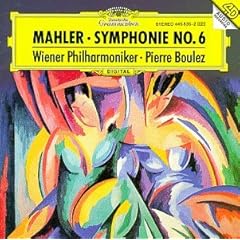
Pierre Boulez/Wiener Philharmoniker
A disappointment, especially after reading several reviews calling this "the" Mahler Sixth. Boulez's Mahler cycle has been described as "cool" Mahler, a departure from the norm. But, honestly, if you're going to buy a High Romantic period recording of what is undoubtedly Mahler's most hyper-emotional symphony, do you want it any other way than "hot?" I think not. The finale becomes a snooze-fest...which bodes terribly for the rest of the work. Moreover, I thought the sound production values were rather terrible.
Artistic Quality: 1.5
Sound Quality: 2


Valery Gergiev/London Symphony Orchestra
Gergiev begins both his recording career as the Principal Conductor of the London Symphony Orchestra as well has the LSO's first complete Mahler cycle with this harrowing performance. Tempos of all four movements are taken at a brisk pace; the LSO's pulsating low strings evoke menace unlike any other performance. Gergiev could perhaps slow down a bit in the finale, and the slow movement isn't nearly as well-controlled and beautifully phrased as Abbado's performance with Berlin. Overall, one of the finest Mahler Sixths available, and certainly the best of the 21st Century besides Abbado/Berlin. The recorded sound is excellent; I have the Hybrid SACD version.
Artistic Quality: 4.5
Sound Quality: 5


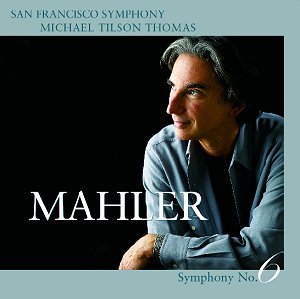
Michael Tilson Thomas/San Francisco Symphony Orchestra
I love Michael Tilson Thomas. And I love his Mahler; his Mahler Seventh with the LSO in the 70s was utterly revelatory, the finest reading of the work ever committed to disc, and his Fifth with the SFSO is particularly fine. But this recording of the Sixth is, in my opinion, an overrated misfire. This Sixth won the Grammy a few years back, and is arguably the most successful release in the Thomas/SFSO cycle, which is a wonder considering its halting phrasing and odd tempo shifts. On the plus side, the recording values are quite good, but far from the standard of Gergiev/LSO. I also bought the Hybrid SACD version of this CD, but even in multi-channel the sound quality failed to live up to the Londoners.
Artistic Quality: 2.5
Sound Quality: 4

A Fresh Start

It is said that the law is a jealous mistress--especially when it comes to competing for attention with other passions.

Being a law student means that my free time is extraordinarily limited, but I have found that the best way of coping with the often excruciating hazing process that is the 1L year is leaning on my love for music more than I have at any time in my life.

Music has always been my greatest passion, and my refuge from the inanities of life. Although I no longer find myself walking on a path towards making music my vocation, I still care more about it than just about anything else in the world.

I hope you find my musings on classical music, orchestras, and recordings informative and interesting. I'll be posting about concerts I attend, the state of classical music in America in this new millennium, reviews of new recordings, and recommendations of older recordings. As with any form of criticism, it is important to remember that art is subjective. My recommended recordings "click" with me and the way I perceive and feel music, but they may not click with you.

I hope that this blog tempts you to find your own taste in music, to explore how music makes you feel, and to seek out performances that speak to your soul in uniquely resonant ways.